


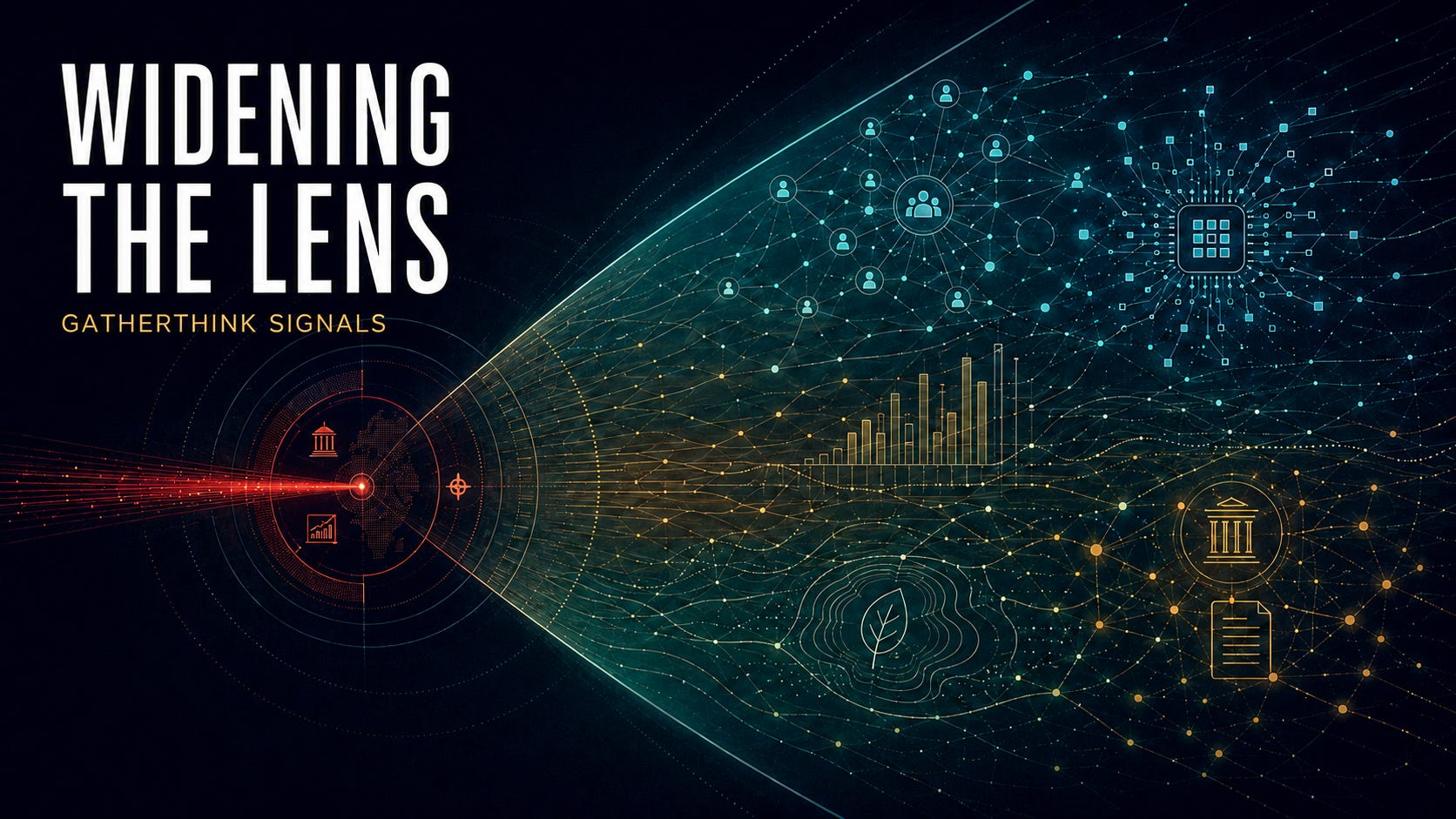
It’s been about a month since we have published Gatherthink Signals. During this time, we have been listening to reader comments and rethinking our product. We built Gatherthink Signals on a simple premise: track geopolitical and macro risk with real rigor and consistent scoring, checked against disconfirming evidence, held accountable with a public track record and connect it to what it means for markets. That premise hasn’t changed. What’s changing is the aperture.
The problem with only scanning for risks. A risk register, by design, only looks where risk already lives. It’s good at telling you when something already on the board gets worse. It’s structurally bad at telling you about the thing that isn’t on the board yet for example the labor-law case that quietly rewrites gig-worker bargaining, the preprint that turns out to matter, the capacity number that jumps when nobody was watching that sector. Those are trend and signal stories, not risk stories, and they often show up as investable and generally consequential well before they’re recognizable as either.
What’s changing. Starting with our next few issues, Gatherthink Signals is widening its lens from a market-risk radar to a full signals-and-trends radar. We’re extending the same rigor we built tracking geopolitical and macro risk to signals and emerging trends across society, technology, the economy, the environment, and policy; wherever something worth watching shows up first. The lead of each issue will be the most consequential new development we’re tracking. Market implications remain a payoff of that analysis, not the reason a story gets covered.
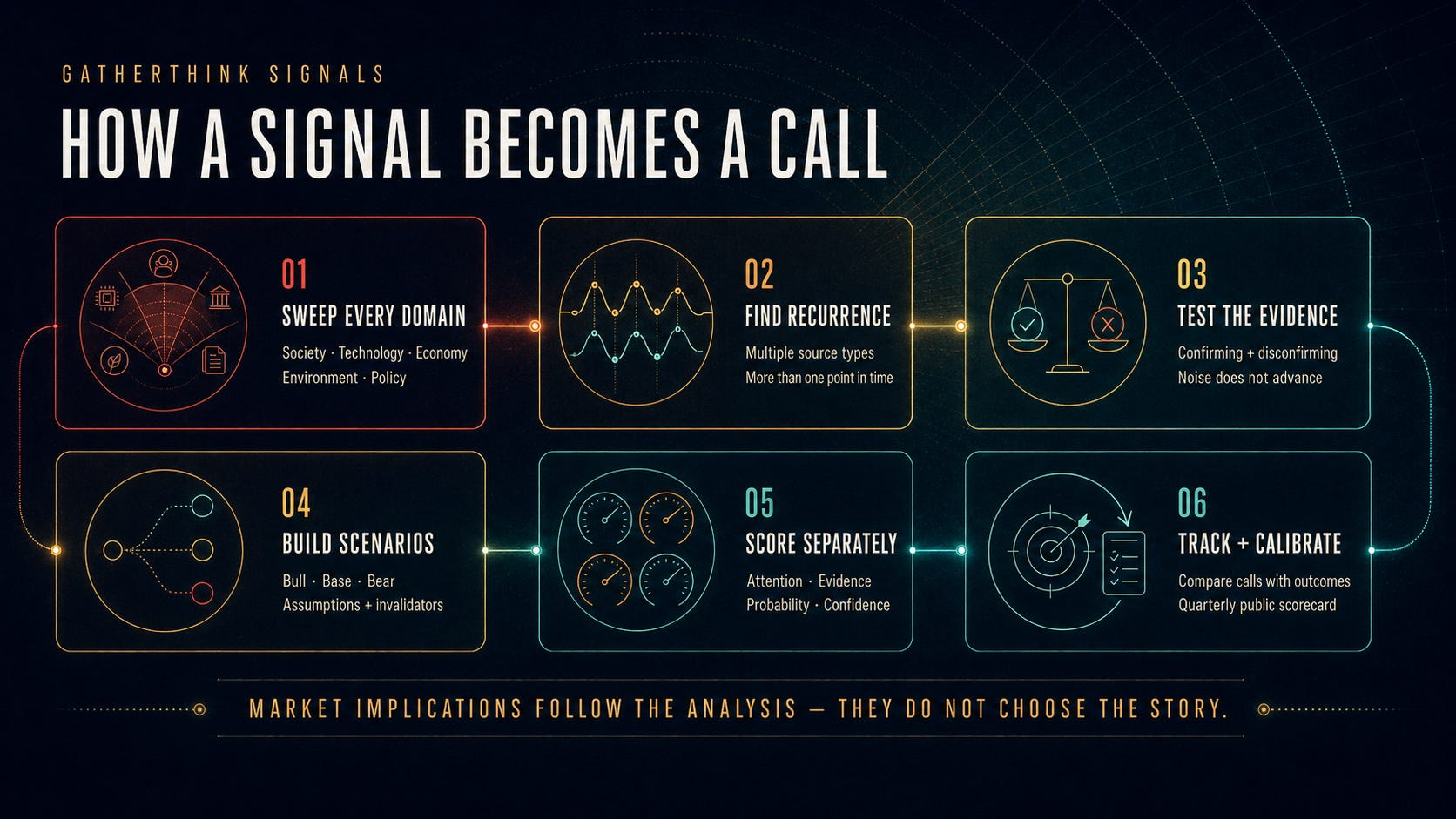
How we do this. Every signal we track goes through the same discipline, regardless of domain. Week to week, we deliberately sweep every domain — society, technology, the economy, the environment, and policy rather than only the ones that already look risky, because the point of a widened lens is catching things before they’re recognizable as risks. A single headline doesn’t earn a place in these pages. We look for a pattern to recur, independently, across more than one kind of source and more than one point in time, before we call it a real trend rather than a week of noise. When something clears that bar, we lay out explicit bull, base, and bear scenarios for it each with its own stated assumptions and a named reason it could be wrong, instead of a single confident prediction dressed up as analysis.
We also keep four things separate that most research quietly blurs together: how much attention something deserves, how solid the evidence behind it actually is, how likely we think a given outcome is, and how confident we are in that likelihood. Collapsing those into one score is a common way forecasting goes wrong, and we’ve built our process specifically to avoid it. Every probability we publish gets tracked against what actually happens and graded in our quarterly calibration scorecard the same public accountability standard we’ve always held ourselves to, now applied to a wider set of calls.
What doesn’t change. Market implications and portfolio-relevant analysis still stay below the paywall. Our public calibration scorecard keeps publishing every quarter. It’s still one subscription, at the same price, covering the weekly brief, the Edge Report, and the monthly deep dive. And the core discipline stays identical: every claim scored for confidence, every thesis paired with what would prove it wrong, nothing here ever framed as investment advice.
What’s coming. We’ll be publishing a preview issue under the new format shortly, so you can see the shift in practice before it becomes the default. Everything else about how you read Gatherthink Signals, the cadence, pricing, the paywall line, the calibration commitment stays exactly where it is.
Disclaimer: Gatherthink Signals is for educational and informational purposes only. It is not investment, legal, tax, or financial advice. It does not consider any individual’s objectives, financial situation, or risk tolerance. Nothing here is a recommendation to buy, sell, or short any security, asset, or derivative. Readers should do their own research and consult qualified professionals before making financial decisions.