


Gatherthink Signals — Weekly Brief
Issue #5 · 2026-06-14 · Cycle 10
Bottom Line
This week stacks the two pivotal monetary decisions of the year into a single 48-hour window: the Bank of Japan is expected to raise policy rates to 1.0% with JGB domestic yields already at 29-year highs, and Kevin Warsh chairs his first FOMC two days later. Layered on top, Iran and Israel traded the worst strikes in months on June 7-8, putting the April ceasefire back under stress. The key question is whether two simultaneously normalizing central banks can do so without cracking the global carry trade.
Risk Scorecard
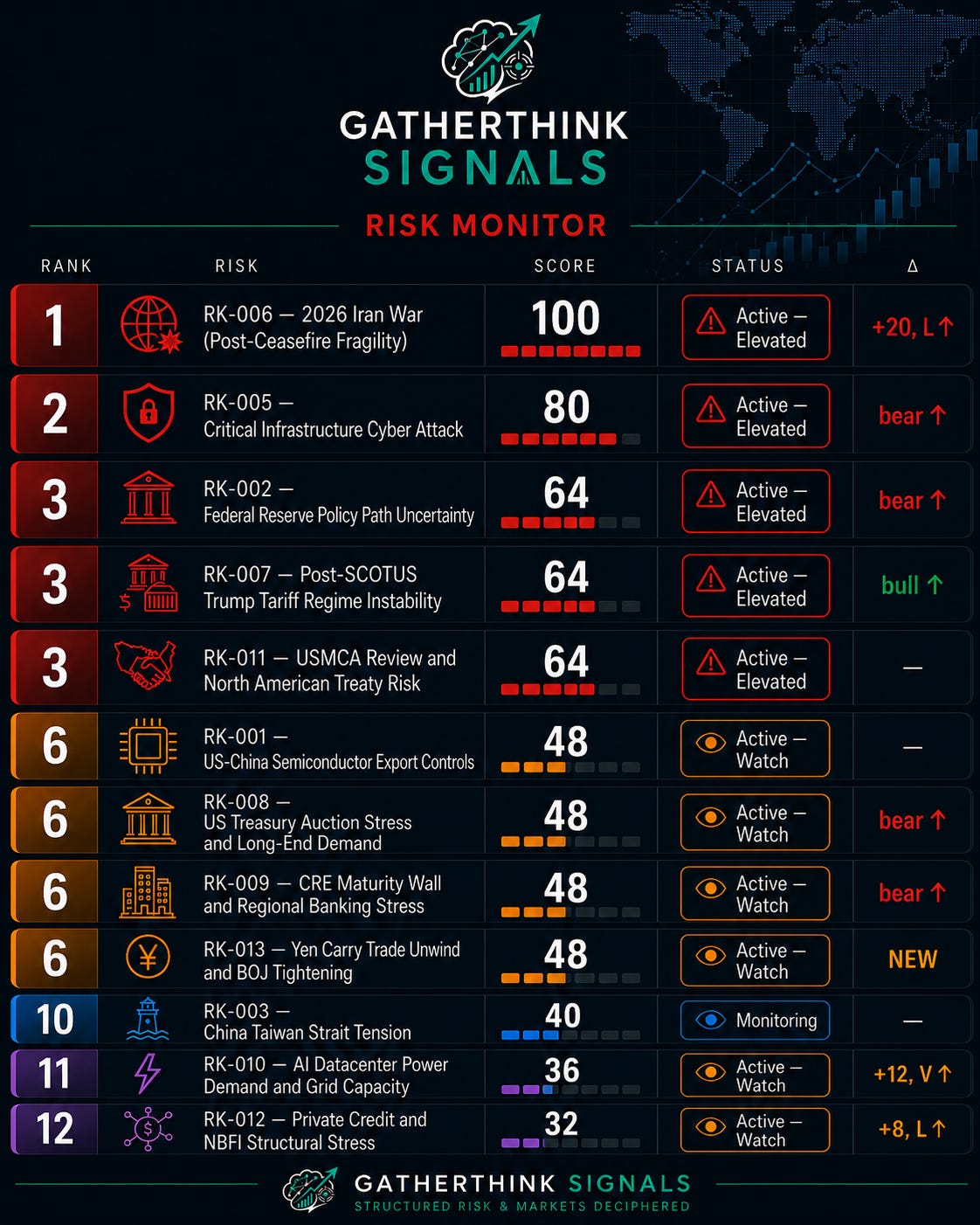
Three of the moves matter most. RK-013 bear probability rose 0.25→0.30 as the BoJ June meeting approached with 10Y JGB at 1.95% (18-year high) and domestic yields at a 29-year high of 2.8%. RK-010 stepped up from 36 to 48 because the binding constraint on AI deployment migrated from power generation to cooling — Coolant Distribution Units are now the gating factor, with liquid cooling expected to double air-cooled capacity by end-2026. RK-014 enters the register at composite 24: France is on its fifth PM in under two years with public debt at ~115% of GDP and a 2026 budget process that risks auto-extension. Top risk RK-006 held at 100 but bear probability ticked higher on the June 7-8 strike exchange.
This Week’s Story
The macro calendar has rarely been this concentrated. Within roughly forty-eight hours, the Bank of Japan and the Federal Reserve will each make their most consequential decision of the year — and they will do so under a leadership transition on the US side and an evidence base on the Japanese side that has already pushed JGB yields to highs not seen since 1997. Markets are not really expecting a Fed rate move on June 17; the question is what Kevin Warsh’s first Statement of Economic Projections looks like, and whether the median 2026 cut count is pushed into 2027 or left open for September. Markets do expect the BoJ to raise to 1.0%; the question is whether forward guidance carries hawkish freight that closes the rate-differential gap fast enough to force a step-function unwind of the $300-500 billion yen-funded carry trade. The two questions are not independent. A hawkish-Warsh / hawkish-BoJ combination compresses the funding-cost gap on both ends simultaneously and stresses the long end of the US curve (RK-008) while bidding the safe-haven dollar (RK-014 channel). A dovish-Warsh / hawkish-BoJ combination is the steepest narrative cliff. Underneath this, Iran’s June 7-8 escalation — the worst strike exchange in months — keeps an oil-shock right tail live (RK-006 bear 0.50). High confidence the cross-asset volatility regime is the variable that matters most this week.
Top Risk — RK-006: Iran / Hormuz Post-Ceasefire Fragility (Score 100)
The April 7-8 ceasefire is still nominally in effect, but the June 7-8 strike exchange was the most serious in months and re-priced Iran’s “complete blockade” pledge as a live possibility rather than rhetoric. Shipping through the Strait of Hormuz remains far below pre-war levels. The United States has announced a counter-blockade on traffic to Iranian ports, and the State Department has stated that any Iranian tolling system “would make a diplomatic deal unfeasible.” There are partial offsets: the UK and France hosted two reopening conferences, and 36-plus countries signed a safe-passage readiness statement. With medium confidence, the net is asymmetrically bear-leaning. Bear probability rose to 0.50 (from 0.45), base eased to 0.40, bull held at 0.10. Bear trigger: a kinetic event in the strait (mine detonation, naval action, or tanker attack) combined with HY OAS widening past 3.5% from the current 2.78% (FRED, 2026-06-11) — the moment credit confirms the geopolitical signal, the transmission becomes systemic rather than headline.
Deep Dive — RK-013: The Yen Carry Trade Meets the Hawkish Test (Score 48, focal risk)
What happened. Japan’s domestic bond yields hit a 29-year high of 2.8% in Q1 2026 and the 10Y JGB now sits at an 18-year high of 1.95%, with markets pricing toward 2.25% as the BoJ moves from 0.75% toward an expected 1.0% at its June meeting. Three BOJ members publicly called for further hikes on April 28. Japan sold roughly $30 billion in US Treasuries in Q1 — the fastest pace of selling in four years — and the rate differential that historically anchored the yen-funded carry trade is shrinking for the first time in a decade.
Scenarios with explicit probabilities. Bull (0.15): BOJ delays the June hike or signals dovish forward guidance; the Finance Ministry manages yen volatility; the carry trade unwinds gradually and US duration absorbs Japanese selling without a yield gap-up. Base (0.55): BOJ delivers the expected 25bp hike to 1.0% with measured guidance; USD/JPY trades a volatile but contained range; episodic carry-trade pressure tightens financial conditions modestly; UST 10Y holds 4.40-4.70%; tech equities face periodic risk-off but no systemic event. Bear (0.30): BOJ surprises with 50bp or signals an accelerated path; JGB 10Y breaks above 3.0%; sudden yen strengthening triggers margin calls; mega-cap tech is repriced sharply; UST long-end gaps higher on Japanese forced selling; cross-asset volatility rivals August 2024.
Market transmission in plain terms (medium confidence). The yen carry is the largest single funding source for global risk assets. A disorderly unwind compresses risk-on positioning everywhere at once — long-duration Treasuries gap, mega-cap tech repricing, EM stress, and a temporary safe-haven dollar bid. Watchlist: FXY, DXJ, EWJ, TLT, QQQ, USDJPY, and the JGB 10Y yield itself.
The single most important bear trigger: the BoJ delivering a hawkish surprise (50bp or accelerated forward guidance) and JGB 10Y closing above 2.25% in the same week. That is the threshold at which the rate differential narrows fast enough to force a positioning unwind rather than a managed walk-down.
The Others
RK-005 (Cyber, 80): CISA + partners issued early-June advisories on active PLC attacks and Phoenix Contact PLCnext privilege-escalation flaws. Sustained probing posture; no acute breach this week.
RK-002 (Fed, 64): Warsh chairs his first FOMC on June 16-17; hold widely priced. The dot plot and tone carry the asymmetry.
RK-007 (Tariff/IEEPA, 64): The Trump administration announced on June 1 it will appeal the federal judge’s order allowing all importers (not just plaintiffs) to seek refunds. Section 122’s 150-day clock and Section 232 anchors remain operative.
RK-011 (USMCA, 64): Review formally opens July 1 — T-18 days. Mexico has held two preparatory rounds; Canada’s chief negotiator has signalled the agreement will not terminate even if July 1 lapses.
RK-001 (Semis, 48): NVDA’s China AI-chip share has fallen from >90% to ~50% per recent analysis; February 2026 saw 8 bipartisan lawmakers call for a blanket equipment-export ban.
RK-008 (Treasury, 48): June 10 $39B 10Y re-opening cleared cleanly at 2.57x bid-to-cover; BofA continues to flag foreign-demand cracks on 20Y/30Y auctions.
RK-009 (CRE, 48): Office CMBS delinquency 12.34% (Jan 2026, GFC+1.6pp); $875B-$936B 2026 maturity wall persists; no acute event this week.
RK-012 (Private credit, 32): Private credit default rate climbed to 9.2% (record, privately monitored ratings) by end-2025; $12.7B 2026 BDC unsecured-debt refinancing wall, up 73% YoY.
RK-003 (Taiwan, 40, monitoring): No June 2026 catalyst surfaced; Phase 5 review will reassess disposition.
RK-014 (France/Eurozone, 24, NEW): Fifth PM in <2 years; debt 115% of GDP; 2026 budget process at risk of auto-extension. OAT-Bund spread still range-bound — the tail is not pricing yet.
What Could Be Wrong
The case for a calmer week than implied above rests on three points. First, the BoJ has a strong institutional preference for dovish surprises when the global cycle is uncertain — the 2024 Q3 pivot is recent memory, and the rate decision plus communication can be highly asymmetric. Second, the April Iran ceasefire has not formally collapsed despite the June 7-8 exchange, and the 36-country safe-passage framework is non-trivial multilateral pressure. Third, credit markets — HY OAS at 2.78% (FRED, 2026-06-11), 10Y at 4.45%, 10Y-2Y still positive at +0.39% — are not pricing the bear case for any of the three top risks. If credit does not confirm, the equity-repricing transmission stays narrative rather than systemic.
What to Watch
2026-06-16/17 — FOMC June meeting; Warsh’s first as Chair; SEP, dot plot, press conference tone (RK-002, RK-008, RK-013)
Mid-June 2026 — BoJ policy meeting; expected hike to 1.0%; hawkish-surprise risk (RK-013)
2026-07-01 — USMCA review formally begins; Mexico’s first formal round (RK-011, RK-007)
Through July 2026 — GENIUS Act regulator-guideline deadline (RK-008 cross-link via stablecoin T-bill demand)
Ongoing — Hormuz shipping flow; any further Israel-Iran strike exchange (RK-006)
Sources Used This Issue
Government & Regulatory: Federal Reserve (FOMC); US Treasury auction calendar; CISA advisories on PLC/ATG systems; Supreme Court (Learning Resources v. Trump, 24-1287); OCC Bulletin 2026-3 (GENIUS Act NPRM); US House of Commons Library (Hormuz briefing).
Research Institutions: CSIS (USMCA Review 2026; China cross-strait); Inter-American Dialogue (USMCA); Wharton (Hinzen et al. on regional banks); Bloom Energy (2026 Data Center Power Report); Lombard Odier (liquid cooling); Permutable AI (Japan normalisation); Advisor Perspectives (yen carry); CAIA (private credit); Moody’s (US corporate default risk).
News & Analysis: CNN (Iran-Israel June 7-8); Marketplace; Fortune; CNBC; Wikipedia; Mitrade; Polymarket; FinancialContent; Dukascopy; Domain-b; Tom’s Hardware; IG International; Investing.com; War on the Rocks.
Legal & Compliance: Norton Rose Fulbright (IEEPA refunds); Consumer Financial Services Law Monitor (Treasury NPRM on state stablecoins).
Threat Intelligence: Cyble (Americas Q1 2026); Industrial Cyber (PLC attacks, Phoenix Contact).
Disclaimer: Gatherthink Signals is for educational and informational purposes only. It is not investment, legal, tax, or financial advice. It does not consider any individual’s objectives, financial situation, or risk tolerance. Nothing here is a recommendation to buy, sell, or short any security, asset, or derivative. Readers should do their own research and consult qualified professionals before making financial decisions.