


Gatherthink Signals — Risk & Markets Weekly
Issue 2 · May 16, 2026
Geopolitical risk, macro signals, and market transmission — structured, scored, and scenario-mapped.
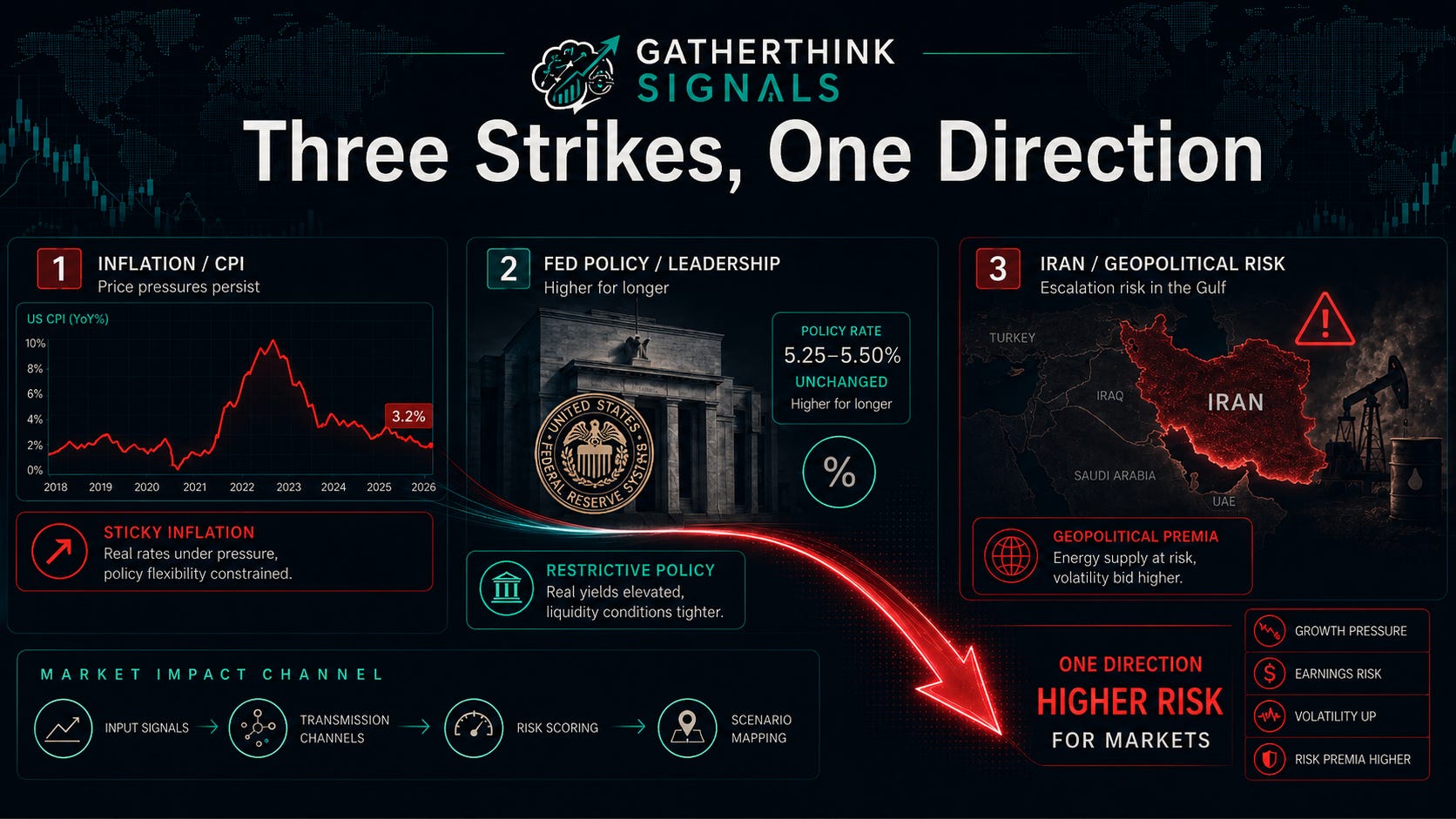
Bottom Line: The week’s three open questions all resolved in the same direction. April CPI printed 3.8% — crossing the bear trigger. Kevin Warsh took the Fed chair on May 15 with no moderating first-day signal. The Trump-Xi summit closed without a semiconductor deal, and Iran rejected the latest peace proposal the day it ended. The base scenario is now the operative environment across every tracked risk. The bear scenario is closer than it was seven days ago.
1. Risk Scorecard
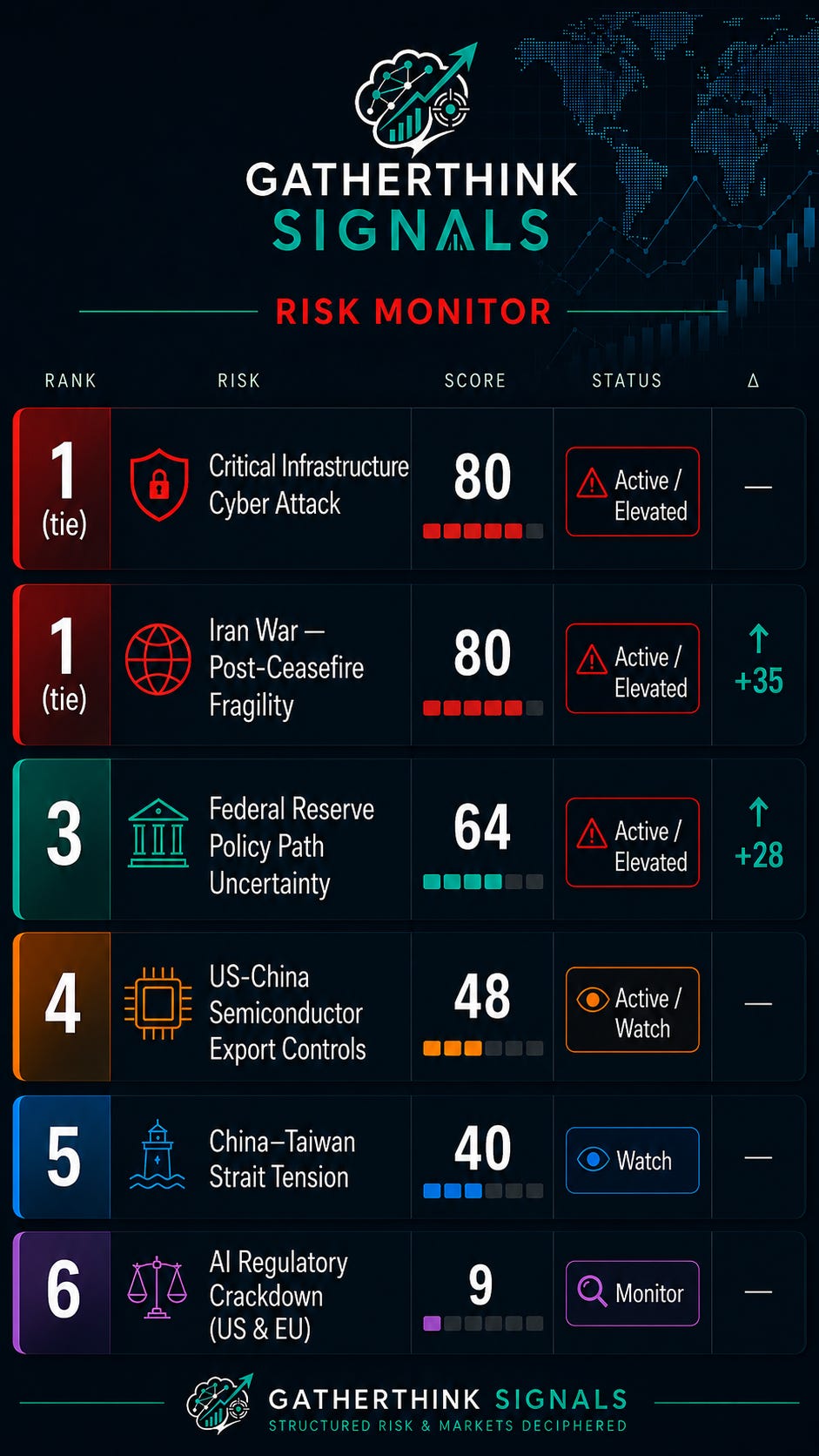
Score = Likelihood × Impact × Velocity (1–125). Monitor ≤20 · Watch 21–60 · Elevated 61–100 · Critical 101–125.
Two risks escalated sharply since Issue 1. RK-006 (Iran War) rose from 45 to 80 (+35) as the ceasefire deteriorated to “on life support,” oil crossed $100 per barrel, and the IEA described the Hormuz disruption as the largest supply shock in the history of the global oil market. RK-002 (Federal Reserve) moved from 36 to 64 (+28) on the April CPI print at 3.8% — the highest since May 2023, directly crossing the stated bear trigger — and the formal Warsh transition. Three risks are now in Elevated territory simultaneously, the most stressed register configuration to date.
2. This Week’s Story
This is the week the risk register’s waiting period ended.
Since Issue 2, three major catalyst events landed — each of which carried the possibility of resolving more constructively. None did. April CPI printed 3.8% year-over-year on May 12, the highest reading since May 2023 and a direct crossing of the threshold this workspace had named as a bear trigger. What made the number significant wasn’t the headline alone: shelter costs re-accelerated by 0.6% month-over-month after appearing to ease; apparel is up 0.6%; airline fares are up 20.7% year-over-year. The “Iran War as isolated energy driver” argument — the primary disconfirming factor for the past two cycles — has materially weakened. Inflation is broadening.
Kevin Warsh took the Federal Reserve chair on May 15 without issuing a first-day policy statement. That silence matters because it leaves the pre-confirmation framework — inflation as a choice, a narrowed mandate, a balance sheet to be shrunk simultaneously with rate cuts — as the operative interpretive frame. Three FOMC members in April had already signaled the next move could as easily be a hike as a cut. Warsh walks into that room at June 16-17 with 3.8% inflation, no public moderating signal, and an untested theory about how to run monetary policy.
The Trump-Xi summit added a third disappointment. H200 chip exports were formally approved, but China directed its firms not to use the framework. Iran rejected the latest US peace proposal the day the summit closed. Xi stated that Hormuz must stay open — and Trump responded by saying he wasn’t asking for any favors. The constructive resolution scenarios for three separate risks all came in below expectations in the same week.
3. Top Risk: RK-006 — 2026 Iran War Post-Ceasefire Fragility
Score: 80 (Elevated) · High confidence · ↑ +35 since Issue 1
The ceasefire that ended the Iran War on April 8 is, in the president’s own words, “on massive life support.” Trump has stated he wouldn’t have been in favor of the pause and accepted it under Pakistani pressure. Iran’s chief negotiator issued an ultimatum: accept Tehran’s 14-point proposal — sequencing Hormuz and sanctions relief before nuclear talks — or face failure. The US wants nuclear concessions first. The deadlock is structural, not rhetorical.
The Trump-Xi summit added new diplomatic texture without operational substance. Xi publicly stated China opposes Hormuz militarization and called the conflict pointless. Trump explicitly declined to ask for Chinese help. Iran rejected the latest US proposal the same day. WTI crude remains above $100 per barrel (FRED, $101.56, May 11). The Strait saw 191 vessel crossings in April against a pre-war monthly normal of roughly 3,000; 600-plus tankers remain stranded in the Persian Gulf.
In a bear case, ceasefire collapse sends oil above $115 per barrel, re-accelerates the energy component of CPI, and hands Warsh a stagflation scenario at his first FOMC. The ceasefire is the thread that holds the macro environment together. Xi’s stated Hormuz position is a genuine new diplomatic context — if Beijing makes direct contact with Tehran, the bull scenario pathway becomes more plausible. That follow-through has not yet materialized.
Bear trigger: Resumption of Iranian proxy attacks (Houthis, Hezbollah remnants) or a Trump statement announcing a return to combat operations.
4. Deep Dive: RK-002 — Federal Reserve Policy Path Uncertainty
Score: 64 (Elevated) · High confidence · ↑ +28 since Issue 1 · Focal risk this issue
The score nearly doubled in two cycles. The story is no longer about what might happen — it is about what is already in motion.
The April CPI print of 3.8% year-over-year crossed the bear trigger named in Issue 2. More consequentially, the composition of inflation has shifted. Shelter costs re-accelerated by 0.6% month-over-month, reversing the easing trend that supported the “energy-only” disconfirming argument. Tariff-sensitive categories are contributing independently — apparel and airline fares are up materially year-over-year. Core CPI at 2.8% is not alarming, but it is not decelerating. The thesis that Iran-driven energy costs are an isolated and self-correcting driver has materially weakened.
Kevin Warsh took the Federal Reserve chair on May 15. His first FOMC meeting is June 16-17. No first-day statement was issued. His pre-confirmation posture — inflation as a choice, dual mandate to be narrowed, balance sheet to be reduced simultaneously with rate cuts — remains the operative framework by default. The “untested” element matters: Warsh’s theory bets that loosening rates while shrinking the balance sheet cancel each other out. If that theory misfires, the inflation response could be more complex than a simple hold-or-hike decision.
The bear scenario for this risk has a distinct market transmission that differs from a plain higher-for-longer outcome. In a stagflation path — elevated inflation meeting a weakening labor market — both equities and long-duration bonds face simultaneous headwinds. The traditional 60/40 hedge relationship breaks. Under this scenario, gold and energy emerge as the primary risk-adjusted beneficiaries; PFIX may warrant attention as a rate volatility expression. HY spreads at 2.76% (FRED, May 14) remain historically tight — credit markets have not confirmed the bear path. That divergence between elevated narrative risk and tight credit pricing is the key tension heading into June 16-17.
Bull (p=0.15): Warsh governs cautiously; May CPI moderates; June FOMC signals eventual cuts. Rate-sensitive assets recover.
Base (p=0.50): Framework shifts gradually; June FOMC holds with hawkish tilt; one cut in late 2026; credit spreads stable.
Bear (p=0.35): Mandate-narrowing framework signaled at June FOMC; Iran re-escalation sustains CPI above 3.5% through H2; stagflation materializes; 60/40 hedge breaks; GLD and XLE scenario beneficiaries; TLT and equity multiple compression simultaneously.
Bear trigger: June FOMC statement with explicit dual-mandate language shift, combined with May CPI holding at 3.5% or above.
5. The Others
RK-001 — US-China Semiconductor Export Controls (48, —): The summit approved H200 exports to ten Chinese firms, but Beijing directed them not to buy — zero chips have shipped, an active state-directed decoupling choice rather than a logistics delay. The MATCH Act cleared the House Foreign Affairs Committee April 22, advancing DUV restriction legislation toward a floor vote with no announced timeline.
RK-003 — China–Taiwan Strait Tension (40, —): Post-summit produced no PLA exercises and no arms sales concessions; Rubio confirmed US Taiwan policy “remains unchanged.” Taiwan is independently deploying HIMARS to Penghu and Dongyin islands; the 14-day post-summit bear-trigger watch window expires May 29.
RK-004 — AI Regulatory Crackdown (9, Monitor): No new developments this cycle; the EU Digital Omnibus deferral to December 2027 holds, and no US legislative movement has emerged. Score remains in Monitor range.
RK-005 — Critical Infrastructure Cyber Attack (80, —): CyberAv3ngers remains confirmed active; the attack vector has shifted to Rockwell/Allen-Bradley SCADA systems (5,600 exposed IPs identified by Unit 42). A 39-day gap since the last CISA advisory is ambiguous — it may reflect successful CI Fortify containment or an operational quiet phase ahead of a larger campaign.
6. What Could Be Wrong
The bear scenario for RK-002 may be overstated. HY credit spreads at 2.76% (FRED, May 14) are historically tight — financial markets are not pricing systemic stress despite 3.8% CPI and a regime change at the Fed. Warsh is one vote among many; FOMC consensus requires coalition-building, not just a new chair. The historical pattern is nearly universal: incoming chairs govern more moderately than pre-confirmation rhetoric implied. And if the Iran ceasefire holds and Hormuz normalizes even partially, the primary inflation driver reverses quickly — taking the bear scenario’s main fuel source with it.
7. What to Watch
Warsh first public speech — before June 16 (RK-002): No first-day statement was issued. Any speech, interview, or Fed communication from Warsh before the June 16-17 FOMC is the first signal on governing style vs. confirmation rhetoric. Explicit dual-mandate or framework language would escalate bear scenario probability.
HY credit spread (BAMLH0A0HYM2) — weekly (RK-002): Currently 2.76% — historically tight. If spreads widen materially toward 3.5%, credit markets are beginning to confirm the bear path. Sustained tight readings through June FOMC are the primary disconfirming signal.
Iran ceasefire status and Beijing-Tehran contact — 7-14 days (RK-006): Xi’s public Hormuz statement created a diplomatic opening that needs operational follow-through to be meaningful. Watch for direct China-Iran diplomatic contact as evidence; simultaneously watch Houthi and proxy activity as the primary bear trigger signal.
PLA 14-day post-summit exercise window — expires May 29 (RK-003): No named exercise has been announced. Any announcement before May 29 raises RK-003 composite from 40 to 60 (Elevated territory).
May CPI and jobs report — early June (RK-002, RK-006): If May CPI holds at 3.8% or above and unemployment drifts toward 4.5%, the stagflation scenario becomes the operative base case for the register — triggering a full macro regime reassessment.
8. Sources Used This Issue
Government & Regulatory
CISA Advisory AA26-097a — Iranian ICS/OT attack campaign, April 7, 2026 (RK-005)
CISA Iran Threat Overview — current advisory status (RK-005)
FINRA Cybersecurity Alert — heightened Iranian threat, May 2026 (RK-005)
BLS Consumer Price Index — April 2026, released May 12 (RK-002)
Federal Reserve FOMC statement — April 2026 (RK-002)
ROC Ministry of National Defense — post-summit PLA activity, May 15, 2026 (RK-003)
Research Institutions
AEI: China & Taiwan Update, May 15, 2026 (RK-003)
BofA semiconductor scenario analysis (ASML revenue impact) via SIG-024 (RK-001)
FRED: DGS10, T10Y2Y, BAMLH0A0HYM2, DCOILWTICO, UNRATE — May 2026 readings
News & Analysis
TechTimes: Trump-Xi summit semiconductor outcomes, May 15, 2026 (RK-001)
Tom’s Hardware: H200 China purchase status post-summit, May 15, 2026 (RK-001)
Fox News / CNN: Iran war ceasefire and post-summit status, May 15, 2026 (RK-006)
Euronews / CNN: Iran negotiation deadlock, May 11-12, 2026 (RK-006)
CNBC: Warsh confirmation and Fed transition (RK-002)
Spectrum News: Powell term end / Warsh takes over, May 15, 2026 (RK-002)
South China Morning Post: Taiwan live-fire drill, Kinmen, May 13, 2026 (RK-003)
Threat Intelligence
Unit 42 / Palo Alto Networks — Iranian cyberattack threat brief, updated April 17, 2026 (RK-005)
Disclaimer: Gatherthink Signals is for educational and informational purposes only. It is not investment, legal, tax, or financial advice. It does not consider any individual’s objectives, financial situation, or risk tolerance. Nothing here is a recommendation to buy, sell, or short any security, asset, or derivative. Readers should do their own research and consult qualified professionals before making financial decisions.