


Gatherthink Signals — Risk & Markets Weekly
Issue 4 · 2026-05-29
Geopolitical risk, macro signals, and market transmission — structured, scored, and scenario-mapped.
Bottom Line: Iran’s tentative MOU remains unsigned — markets priced the deal, not its completion. Meanwhile two developments moved largely below radar: Section 232 tariffs on copper and semiconductors are already law, not forecast; and the USMCA’s formal review began today with contentious bilateral talks 33 days from a treaty sunset decision. The week’s story is not the one everyone was watching.
1. Risk Scorecard
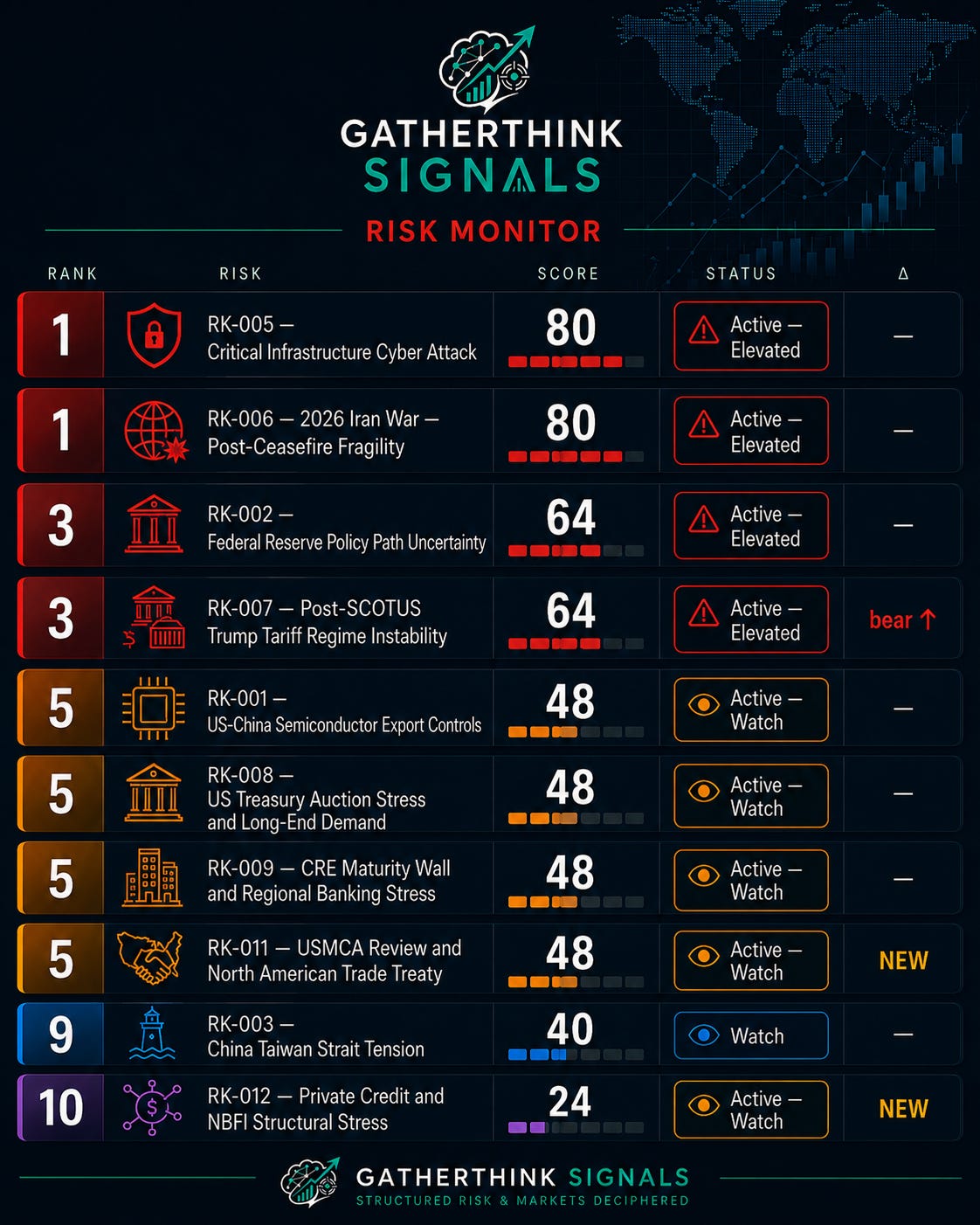
One scenario change. RK-007 bear probability raised from 0.25 → 0.30: Section 232 tariffs on copper (50%) and semiconductors (25%) were confirmed as already enacted in June 2025 — what the prior register entry listed as a scenario risk is now confirmed fact. Canada is actively retaliating. EU €93B retaliation package stands ready. All other scores held.
2. This Week’s Story
Last week’s dominant story was Iran. A tentative MOU pulled WTI down 13%, reshaped Kevin Warsh’s June 17 inflation picture, and pushed the Fed bear trigger more than $14 further out. The market did what markets do — it priced the probability and stopped waiting for the signature. That signature has still not arrived.
What this week revealed is that the Iran trade was masking a parallel one. Today — May 29 — the United States and Mexico opened the USMCA’s first formal bilateral negotiating round since the six-year review was triggered. The agenda was economic security and rules of origin. Foreign Policy reduced the session to five words: “U.S.-Mexico ties falter.” Round two lands June 16-17 in Washington, the day before the FOMC. The July 1 deadline is 33 days away. If the three governments cannot jointly agree to extend, a 10-year sunset countdown begins.
The same horizon-scan that surfaced USMCA corrected an older error in the register. Section 232 tariffs on copper (50%) and semiconductors (25%) — carried in prior issues as scenario risks — turn out to be enacted law since June 2025. Canada is already retaliating; the EU’s €93B response stands ready. The “other trade war” was not a forecast. It was a fact the register had not yet caught up to.
3. Top Risk: RK-005 — Critical Infrastructure Cyber Attack (Score: 80 | Elevated)
The CISA advisory gap now stands at 52 days, past the 45-day flag threshold set in prior cycles and closing on the June 6 decision point. Nothing has been issued since AA26-097a on April 7. No Tier 1 infrastructure — the bulk electric grid, core financial utilities — has been confirmed compromised.
The silence is analytically ambiguous. With medium confidence, the gap may reflect either the CI Fortify initiative’s containment effects (launched May 5) or Iranian operational restraint during the MOU negotiation window — a calculated pause while a diplomatic track is open. If the second reading is correct, the same deal suppressing RK-006 and RK-002 is also suppressing RK-005. A deal collapse would move all three simultaneously, in the same direction, at velocity:5 — a confluence the issue’s bear case understates.
The score holds at 80 (L:4 × I:4 × V:5). Velocity stays at five because demonstrated destructive capability — 200,000 devices wiped in the Stryker incident — is independent of current operational tempo. June 6 is the formal decision point. A clean pass without a new advisory or Tier 1 incident sets up a likelihood downgrade proposal (L:4 → L:3, composite 80 → 60) for user review. A new advisory naming bulk power or systemically important financial infrastructure triggers an immediate bear rescore.
4. Deep Dive: RK-011 — USMCA Review and North American Trade Treaty Risk (Score: 48 | Watch)
What happened. The United States and Mexico opened the USMCA’s first formal bilateral negotiating round today, May 29. The agenda covered economic security and rules of origin. Foreign Policy characterized the session as contentious and underlined the deterioration in bilateral framing. Round two follows June 16-17 in Washington (agriculture and “level playing field”); round three is scheduled for the week of July 20 in Mexico City. Canada is observing more than participating in the bilateral track — Ottawa’s posture matters because all three governments must agree for any extension to take effect.
Why the deadline is hard. Under the review mechanism, the three parties have until July 1 to jointly agree to extend USMCA for 16 years. Failure to agree triggers a 10-year annual-review sunset countdown with formal termination July 1, 2036. The Trump opening package is not incremental: tightened automotive rules of origin (raising North American content thresholds), forced-labor import prohibitions, restrictions on Chinese-owned companies operating inside North American supply chains, and cartel-enforcement measures linked to trade access. The Sheinbaum government arrived under domestic pressure not to make unilateral concessions on the migration and enforcement asks Trump has tied to market access.
Scenarios (initial entry). The bull scenario (p=0.25) is an extension reached before July 1 with modest rules-of-origin concessions and reduced retaliation surface. The base scenario (p=0.55) — the CSIS baseline — is the “painful extension”: talks stretch past July 1 via deadline flexibility, Mexico and Canada accept meaningful tightening on automotive content and Chinese-company restrictions, but the framework survives; CAD and MXN remain volatile through Q3. The bear scenario (p=0.20) is sunset countdown triggered: sustained treaty uncertainty, retaliatory escalation above current Section 232 levels, and early reshoring decisions in the supply chains most dependent on USMCA access.
Market transmission. With medium confidence, the primary channels are currency-stress (MXN and CAD as the daily pricing mechanism for treaty risk), supply-disruption in automotive and agricultural supply chains, and cross-risk amplification with RK-007 — a bear outcome for RK-011 materially expands the legal space for retaliation under existing tariff authorities. EWW and EWC are the most direct ETF exposures. F, GM, and STLA carry the highest automotive rules-of-origin exposure among publicly traded names.
The single most important bear trigger: failure to reach a framework agreement on or before July 1 — the sunset countdown begins. Thirty-three days away.
Macro snapshot (FRED, 2026-05-27/29): WTI $97.63 (−13% from May 19 on Iran deal optimism, $17+ from bear trigger); DGS10 4.48% (−19 bps); HY spread 2.71% (tightening, no credit stress signal); T10Y2Y +0.46% (no recession signal). Macro readings are consistent with base scenario improving; no equity or volume confirmation available for this date.
5. The Others
RK-006 — 2026 Iran War (Score: 80, —): MOU still unsigned as of May 29. Framework agreed (CNN, May 28); Trump has not signed. WTI holds $97.63 — markets have priced deal probability, not deal completion. Bear trigger: deal collapse → WTI above $108 within days.
RK-002 — Federal Reserve (Score: 64, —): June 17 is Warsh’s first FOMC. Easing bias expected to be removed. June 10 CPI is the decisive pre-FOMC data point. USMCA round 2 falls June 16-17 — the day before FOMC. Two major trade/macro signals arrive within 24 hours of the rate decision.
RK-007 — Tariff Regime (Score: 64, bear ↑): Bear probability raised from 0.25 to 0.30. Copper and semiconductor Section 232 tariffs confirmed as enacted June 2025 — Canada actively retaliating. Pharma is the next widely-cited Section 232 candidate. Cross-link to RK-011: a bear outcome for USMCA amplifies bear for RK-007.
RK-001 — US-China Semiconductors (Score: 48, —): MATCH Act Senate companion bill remains at introduction stage. No committee action, no floor vote scheduled. Semiconductor Section 232 (25%) adds a domestic tariff-cost channel separate from export-control risk.
RK-008 — Treasury Auction Stress (Score: 48, —): Next 30Y auction June 15 (announcement June 4). Bidding deadline June 11. The June 15 auction lands between the June 10 CPI print and the June 17 FOMC — three high-signal events in one week.
RK-009 — CRE / Regional Banks (Score: 48, —): FDIC confirms 2 bank failures in 2026 — base scenario (managed consolidation) is holding. OFR latent-distress metric is 4x reported delinquency rates; $330B unrealized bank securities losses remain outstanding.
RK-003 — Taiwan Strait (Score: 40, —): Post-summit watch window closed without a named exercise. Watch whether elevated May patrol frequency (4/month) sustains in June. No named exercise or formal arms decision this cycle.
RK-012 — Private Credit / NBFI (Score: 24, NEW): Late-2025 leveraged loan defaults, rising PIK toggle rates, Q1 2026 BDC class-action lawsuits. ~$1.5T AUM in direct lending and semiliquid structures. BKLN vs. HYG spread widening is the early warning to watch.
6. What Could Be Wrong
The most dangerous assumption in this issue is that the Iran MOU’s probability-pricing was accurate. If Trump signed the deal off-camera before June 10, WTI could continue declining and May CPI could show meaningful moderation — in which case this issue’s emphasis on trade risks may appear overstated relative to the dominant market narrative. On USMCA: the July 1 deadline has procedural flexibility — all three governments have strong economic incentives to avoid collapse, and deadline extensions are possible without triggering the sunset clause. The painful base case has a high prior probability of resolving without the bear outcome materializing.
7. What to Watch
USMCA round 2 — June 16-17, Washington (RK-011): Agricultural and “level playing field” agenda. Any automotive rules-of-origin proposal signals bear risk for North American supply chains. MXN and CAD are the daily pricing mechanisms — sustained CAD weakness is the treaty-stress signal.
Trump MOU signature / Iran deal status (RK-006, RK-002): Still the binary governing WTI, CPI, and the Fed path simultaneously. An unsigned deal as of June 10 means May CPI is interpreted under full Hormuz uncertainty. A signed deal shifts the scenario immediately.
May CPI — June 10 (RK-002): PPI at 6.0% is the pipeline. WTI at $97.63 is the valve. If tariff-sensitive categories (apparel +0.6% MoM, airfares +20.7% YoY) prevent moderation despite WTI decline, the base scenario holds; if CPI drops below 3.5%, bear probability for RK-002 retreats materially.
30Y Treasury auction — June 15 (RK-008): Three high-signal events in one week: June 10 CPI, June 15 30Y auction, June 17 FOMC. If the June 15 30Y auction produces a significant tail (yield well above 5%), it adds a fiscal-stress signal directly before the FOMC meeting.
CISA June 6 threshold (RK-005): The 60-day advisory gap decision point. If passed without escalation: likelihood downgrade proposal (L:4→L:3, composite 80→60) goes to user for approval. New advisory naming bulk power or financial infrastructure: immediate bear rescore.
Disclaimer: Gatherthink Signals is for educational and informational purposes only. It is not investment, legal, tax, or financial advice. It does not consider any individual’s objectives, financial situation, or risk tolerance. Nothing here is a recommendation to buy, sell, or short any security, asset, or derivative. Readers should do their own research and consult qualified professionals before making financial decisions.