


The Signal
Europe is preparing to weaken one of its own environmental protections to keep critical minerals flowing. The European Commission is planning to rewrite a key law to let water-intensive mines operate in regions already suffering from drought — a move environmental groups have called “Russian roulette” (The Guardian, June 20). The trade-off is stark: the mining industry’s own trade body reported this month that 38% of mining facilities worldwide already sit in high-to-extreme water stress. It lands alongside two other physical-constraint stories — a Texas–Oklahoma winter wheat crop reported as the smallest since 1957, amid a drought some measures rank the worst in 900 years, and warnings of a “super” El Niño that could cut roughly 14% from global farm output, with food-price shocks into 2028.
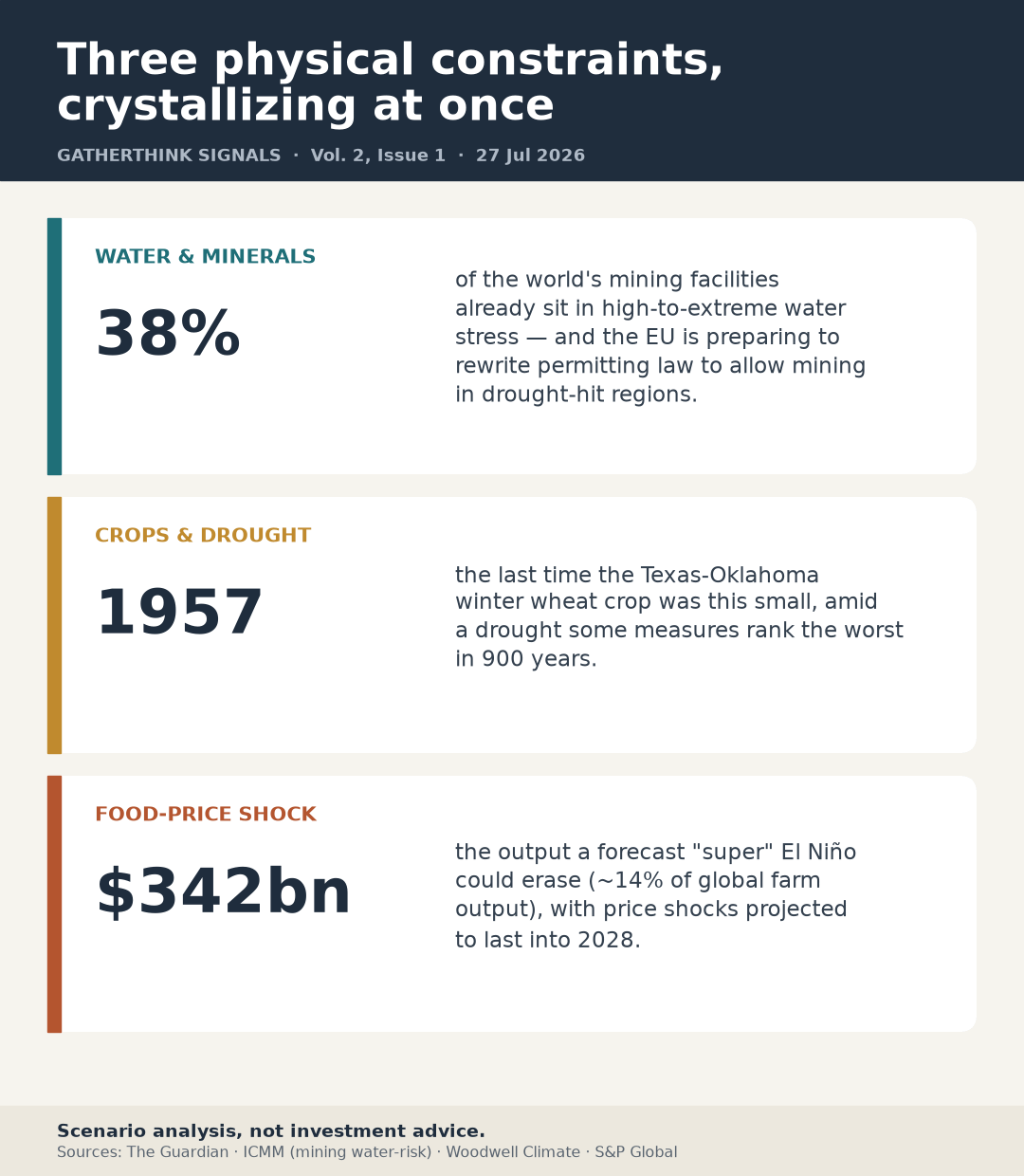
The three constraints behind this week’s lead, at a glance. Sources: The Guardian, ICMM, Woodwell Climate, S&P Global.
Why This Matters
For years, environmental scarcity has been treated as a modeled, forward-looking risk — priced at a discount, planned around rather than paid for now. What connects them is that the discount is starting to disappear. A regulator does not rewrite environmental law to unlock supply unless the constraint has become binding enough to force a choice; the EU’s move is scarcity showing up as a policy trade-off, not a forecast. The same shift shows in the other two: a “worst since 1957” harvest is a realized shortfall, and the super-El-Niño warning puts a number — roughly $342 billion in lost output — on a scenario once described only in ranges.
None of this is one causal chain — water stress on mines, drought on crops, and weather on insurance markets are independent processes. What makes them worth reading together is that each is crossing the same threshold at once: the point where accumulated physical stress can no longer be absorbed by the buffers built to hold it — desalination, crop insurance, actuarial models — and becomes a cost someone must act on now. The question is not whether these risks exist, but which balance sheets and policy regimes have assumed they still sit safely in the future. Confidence: medium — the pattern has reaccelerated sharply after several quiet weeks, but rests partly on a law still in draft and a forecast not yet realized.
Where It Could Show Up
If physical scarcity keeps converting from modeled risk into realized cost, the pressure points cluster where old assumptions are embedded. Mining operators in water-stressed regions without recycling or desalination face the most direct exposure if permitting fights or water limits constrain output. Insurers that priced weather risk to historical rather than current patterns are a second pressure point, as are buyers still planning around pre-drought yields in the US Southern Plains. Possible beneficiaries if these constraints bind include water-recycling and desalination providers, and the catastrophe-modeling firms supplying updated climate-risk models to carriers and regulators. Market confirmation: not assessed — no market snapshot available. This is scenario framing, not a positioning call — we can’t assert markets are repricing without the data.
What Would Prove Us Wrong
Each leg has its own deflating reading. The EU measure is still a draft — it could be narrowed or fail amid the opposition it has drawn, and a permitting change that unlocks supply would relieve the constraint, not confirm it. A single bad regional wheat crop says little about global supply, diversified across Russia, the EU, and Australia. The insurance leg — which would show these constraints hitting balance sheets — has been quiet lately. And the El Niño figure is a forecast, not a realized shock. Read skeptically, this is three loosely-related stories in one news window.
Also on the Radar
The AI trust gap we led with last time deepened: a study across 67 frontier models found stacking models cuts reliability far less than assumed — they fail on the same inputs at once — and fabricated AI citations spread into medical journals.
Administrative deregulation broadened: a transportation-department rule became the fifth federal agency we’ve logged expanding its own discretion, against a tally near five deregulatory actions per new rule.
New on our radar: warnings that the AI build-out’s financing may be partly circular — chipmakers and customers funding each other in ways one congressional witness likened to the dot-com run-up.
Watch Next
Whether the European Commission publishes an actual draft of the mining/water-permitting amendment
NOAA confirmation of El Niño onset and its early read on global grain yields; the next USDA WASDE report
Second-half 2026 insurance-claims data — whether weather stays the dominant cost driver or reverts
How many of the SEC’s 38 listed 2026 rulemakings reach formal proposed-rule stage by December 31
Whether any study directly tests, rather than merely echoes, the AI-output reliability critique still missing its corroboration
Appendix
Driver Scorecard (priority score — likelihood × impact × velocity)
Driver Priority Score Δ Status AI capability-trust gap 48 (Watch) 0 Monitoring Administrative-level regulatory reshaping 36 (Watch) 0 Monitoring
Trend Candidate Scorecard (evidence-strength label, not a score)
Trend Candidate Evidence Strength Status Physical constraints crystallizing into cost Moderate Candidate Supply-chain resilience re-architecture Moderate Candidate
Track record: Volume 2 hasn’t resolved enough forecasts for its own calibration scorecard yet — an honest cold-start note. Our first public scorecard is due early Q4.
Sources:
News & Analysis: The Guardian (”’It’s Russian roulette’: alarm as Europe backs critical minerals mines in water-stressed regions,” 2026-06-20); The Guardian (”’Super’ El Niño could cause global food price shock lasting into 2028,” 2026-07-12); VentureBeat (”Enterprises using multiple AI models are underestimating failure rates by 2.25x,” 2026-07)
Research & Institutions: International Council on Mining and Metals, 2026 water-risk analysis (via Mining Weekly, 2026-07-22); Woodwell Climate Research Center (Texas/Oklahoma winter wheat, worst-since-1957); S&P Global (”Critical minerals shortage threatens US military production capacity”); Deloitte 2026 Semiconductor Industry Outlook (AI-vendor circular financing)
Academic & Primary: Copernicus, Earth System Dynamics (crop-shock frequency projection); arXiv 2606.27288 (co-failure ceiling across 67 frontier models); STAT/The Lancet and Fortune (fabricated citations in medical literature)
Policy & Legal: Competitive Enterprise Institute / American Action Forum (2026 Unified Agenda, ~5:1 deregulatory ratio); Hunton Andrews Kurth (DOT final rule expanding agency discretion)
Disclaimer: Gatherthink Signals is for educational and informational purposes only. It is not investment, legal, tax, or financial advice. It does not consider any individual’s objectives, financial situation, or risk tolerance. Nothing here is a recommendation to buy, sell, or short any security, asset, or derivative. Readers should do their own research and consult qualified professionals before making financial decisions.